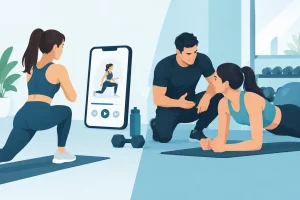

A 6:00 a.m. workout can feel very different depending on what happens when you walk through the door. In one setting, you find a packed room, a prescribed workout on a whiteboard, and an instructor leading everyone at the same pace. In another, a trainer is waiting with a session built around your body, your schedule, and the progress you made last week. That is the real choice behind individual coaching versus group classes.
Both options can improve fitness. The better choice depends on what you need from your training: personal attention, energy from others, a highly flexible plan, a set class time, or a private environment where you can focus without feeling watched. For South Tampa adults with demanding schedules and specific goals, the difference can determine whether exercise becomes a lasting routine or another short-lived attempt.
Individual Coaching Versus Group Classes: The Core Difference
Group fitness classes are designed around shared experience. A coach leads multiple participants through the same broad format, whether that means strength circuits, boot camp intervals, yoga, cycling, or conditioning. Good classes create momentum. The music, instructor energy, and people around you can make it easier to show up and work hard.
Individual coaching is built around the person, not the format. The trainer can adjust exercise selection, resistance, pace, rest periods, and technique in real time. Your session can reflect a demanding workweek, a sore shoulder, a return to exercise after time away, or a specific performance goal. Rather than fitting yourself into a workout, the workout fits you.
That distinction matters because two people can have the same goal on paper, such as losing body fat or getting stronger, while needing entirely different starting points. One may need confidence with basic movement patterns. Another may need a carefully progressed plan after an injury. A third may be experienced but stalled by inconsistent programming. A group class may provide a challenging workout for all three, but it cannot provide the same level of individual adjustment.
When Group Classes Can Be a Strong Choice
For some people, group training is exactly what gets them moving. If you thrive on a set schedule, enjoy a social atmosphere, and like the accountability of familiar faces, classes offer a useful structure. They can also be a cost-effective way to access instruction and variety.
Classes work especially well when you are comfortable modifying movements on your own and can recognize the difference between productive effort and poor form. If the workout includes exercises you cannot perform safely, you need the confidence to choose an appropriate alternative without losing the purpose of the session.
The trade-off is that classes have to serve the room. An instructor may offer modifications, but their attention is divided among every participant. In a busy class, there is limited time to correct your squat depth, adjust your rowing technique, understand why your knee is uncomfortable, or change the plan when your energy is low. This is not a failure of the instructor. It is simply the reality of one coach managing many people.
Group classes can also be less predictable for busy professionals. A fixed class time may be motivating when your calendar is stable, but difficult when meetings run late, travel appears, or family responsibilities change. Missing a class can make consistency harder, especially when the next available option does not fit your day.
Why Individual Coaching Delivers More Precision
One-on-one training replaces broad instruction with direct attention. Every exercise has a reason, and every part of the session can be adjusted based on how you move that day. This is valuable for beginners, but it is not only for beginners. Experienced exercisers often make faster progress when a qualified trainer identifies gaps in their technique, programming, recovery, or training intensity.
In a private session, coaching is immediate. Your trainer can spot a compensation pattern before it becomes a habit, change a movement that does not feel right, and explain what you should feel during an exercise. Those details build confidence. They also help clients train with greater purpose rather than simply trying to get through a hard workout.
Personal training also supports progression. Results require more than sweating for 30 minutes. Strength, cardiovascular conditioning, mobility, and body composition improve when training becomes progressively more appropriate over time. An individual coach can track performance, increase challenge when you are ready, and pull back when recovery demands it.
For a client returning from injury or managing physical limitations, that level of judgment is often essential. Training should feel challenging, not careless. A well-designed program helps rebuild strength and capacity while respecting what your body needs now. It can also help prevent the common cycle of doing too much too soon, getting discouraged, and stopping altogether.
Privacy Changes the Training Experience
Many people avoid gyms for reasons that have nothing to do with motivation. They may feel self-conscious learning new movements, dislike crowded equipment areas, or simply prefer not to make fitness a public activity. Those preferences are legitimate, and they affect consistency.
A private training environment removes many of those barriers. You can ask questions, take time to learn proper form, and focus on your session without competing for equipment or worrying about who is nearby. For clients who have felt intimidated in commercial gyms, privacy often turns exercise from something they avoid into a part of the week they can manage with confidence.
Privacy also creates efficiency. In a dedicated private room, the trainer has the equipment and plan ready for you. There is no searching for an open bench, waiting for a cable station, or losing momentum in a crowded floor plan. A focused 30-minute session can be highly productive when every minute has a purpose.
This is one reason clients choose UST Personal Training. The appointment-only private studio model is designed for people who want expert coaching, modern equipment, and complete focus without the pressure or distractions of a large gym. Sessions are personalized, with guidance that can extend beyond the workout to cardiovascular fitness and dietary planning.
Consider Your Goal, Not Just Your Motivation
The best format is rarely the one that looks most intense online. It is the one that meets your current needs and gives you a realistic path to continue.
If your goal is general activity, stress relief, or adding variety to an already active lifestyle, group classes may be enough. The shared energy can make exercise enjoyable, and enjoyment matters. A routine you look forward to has real value.
If your goal is more specific, individual coaching tends to offer a clearer advantage. Consider personal training when you want to build strength with measurable progression, improve movement quality, work around an injury history, prepare for an event, change body composition, or make the most of limited training time. These outcomes benefit from assessment, planning, and regular adjustments.
It is also worth considering your relationship with accountability. Some people push harder in a room full of people. Others show up more consistently when a trainer knows their goals, notices when they are struggling, and provides direct encouragement. Neither response is better. The key is being honest about what keeps you engaged after the first few motivated weeks.
The Cost Question Requires a Bigger View
Group classes usually have a lower cost per session, and that is a meaningful advantage. For someone who can attend consistently, train safely, and enjoy the format, they can provide excellent value.
Personal coaching is a premium investment because it includes expertise, preparation, individualized programming, and undivided attention. But value should be measured by more than the price of one workout. If coaching helps you train consistently, avoid wasted time, build confidence, and make progress toward a goal that has been frustrating for years, the return can be significant.
Look at the full picture: how much time you have, how much guidance you need, and how likely you are to stay with the program. A lower-cost option that you rarely use is not necessarily the better value. Likewise, personal training only works when you are ready to participate consistently and apply the guidance between sessions.
A Practical Way to Choose
Start by asking what has stopped you before. Was it boredom, lack of instruction, discomfort in crowded gyms, a schedule that never worked, or uncertainty about what to do? Your answer points toward the format most likely to support you.
Choose group classes if you want community, enjoy shared intensity, and feel comfortable taking responsibility for modifications and form. Choose individual coaching if you want a private setting, a program built around your needs, and an experienced professional focused on your progress from the first repetition to the last.
You do not have to choose a format for life. Some clients use personal coaching to establish technique, strength, and confidence, then add classes for variety. Others use classes as an active complement to a structured personal training plan. The right approach can change as your fitness, schedule, and goals change.
The most useful next step is not to search for the hardest workout. Choose the setting where you can show up consistently, train safely, and receive the level of support that makes progress feel possible.