
A strong core is not about holding a longer plank or making your abs more visible. It is about creating control through your trunk so you can lift, walk, run, sit, reach, and train with greater confidence. Learning how to build core stability means training your body to resist unwanted motion while still moving well everywhere else.
For busy adults, that distinction matters. You do not need an hour of floor exercises to improve your core. You need a focused plan that matches your current strength, movement quality, injury history, and goals. Done correctly, core training can make everyday movement feel easier and make the rest of your workouts more productive.
What Core Stability Really Means
Your core includes far more than the rectus abdominis, commonly called the six-pack muscles. It also includes the deeper abdominal muscles, obliques, diaphragm, pelvic floor, and muscles that support the spine and hips. These muscles work as a coordinated system to manage pressure, maintain position, and transfer force between your upper and lower body.
Core stability is your ability to control that system under changing demands. Think about carrying groceries in one hand, standing up from a low chair, placing luggage overhead, or performing a deadlift. Your body needs enough trunk control to prevent excess twisting, bending, or arching while your arms and legs do their job.
That is why hundreds of crunches are rarely the best answer. Crunches train spinal flexion, which can have a place in a balanced program for some people. But most daily activities and strength exercises demand that you resist motion, not repeatedly create it. A well-designed core program develops bracing, breathing, alignment, and controlled movement.
Start With Breathing and Bracing
Before adding challenging core exercises, learn to create tension without holding your breath or squeezing every muscle as hard as possible. Effective bracing should feel firm and controlled, not rigid or strained.
Start lying on your back with your knees bent and feet on the floor. Place one hand on your ribs and the other on your lower abdomen. Take a slow inhale, allowing your rib cage and abdomen to expand in all directions. On the exhale, gently tighten around your midsection as if preparing for someone to lightly tap your stomach. Your ribs should stay stacked over your pelvis rather than flaring upward or flattening your lower back aggressively into the floor.
This breathing pattern helps you build pressure through the trunk while maintaining a neutral, usable position. It is especially valuable for beginners, people returning to exercise, and anyone who feels lower-back discomfort during ab exercises.
The goal is not to pull your stomach in as tightly as possible. Instead, create a 360-degree brace that supports the torso. As your training progresses, use that same brace before a squat, row, loaded carry, or any movement that challenges your posture.
Train the Core to Resist Movement
The most effective way to build core stability is usually to train several forms of resistance: resisting extension, rotation, side bending, and unwanted movement at the hips or low back. Each pattern prepares you for different demands in training and daily life.
Resist Excessive Arching
Exercises such as dead bugs, front planks, and stability-ball rollouts teach the core to resist excessive extension, or an over-arched lower back. A dead bug is often the better starting point because you can control the range of motion and keep your back comfortable against the floor.
Move slowly. If your ribs flare, your back arches, or you lose your breath, reduce the range of motion. Quality repetitions build stability. Rushing through a difficult variation simply teaches compensation.
Resist Rotation
Rotation control matters whenever one side of your body works differently from the other. Pallof presses, cable holds, and single-arm rows are excellent options because they challenge the obliques without requiring aggressive twisting.
For a Pallof press, stand sideways to a cable or resistance band, brace your trunk, and press the handle straight out from your chest. The resistance will try to rotate you. Your job is to remain still through your rib cage and hips. Start light enough that you can breathe normally and hold a steady position.
Resist Side Bending
Side planks and suitcase carries train the body to resist lateral flexion, or bending sideways. This is particularly useful for improving control during walking, running, carrying, and single-leg strength work.
A suitcase carry is simple but demanding. Hold one dumbbell at your side, stand tall, and walk slowly without leaning toward or away from the weight. Keep your shoulders level, ribs stacked over your pelvis, and steps controlled. It is a highly efficient choice for clients who want meaningful training results in a focused 30-minute session.
Build Strength Through the Hips and Upper Back
A core program cannot be separated from the rest of your body. If your glutes, upper back, and legs are not contributing well, your lower back often tries to do more than it should.
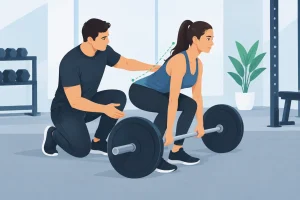
Squats, split squats, hip hinges, rows, presses, and carries all challenge the core when they are coached with proper technique and appropriate loading. A goblet squat, for example, requires you to brace while your hips and knees move. A single-arm dumbbell row requires the trunk to stay organized while one arm pulls. These are practical opportunities to build core stability without turning your entire workout into an ab circuit.
The right exercise depends on the person. Someone rebuilding after back pain may begin with supported movements, bodyweight patterns, and light carries. An experienced lifter may benefit from heavier unilateral work, advanced plank variations, or more demanding loaded carries. Progression should be earned through clean movement, not forced by a calendar.
Use Smart Progressions Instead of Harder Tricks
Core exercises become more difficult by changing leverage, load, stability, duration, or body position. The best progression is the one that challenges you without changing your form.
For example, progress a dead bug by extending one leg farther, then adding an opposite arm reach, then holding a light weight. Progress a plank by improving alignment and breathing before extending the hold. Longer is not always better. A focused 20-second plank with strong positioning can be more valuable than a 90-second hold with sagging hips and held breath.
Most people do well with two to four core-focused movements per week, often placed within a full-body strength program. Choose two or three exercises per session, perform two to four controlled sets, and stop when your technique starts to fade. You should feel your trunk working, but you should not experience sharp pain, numbness, or worsening back symptoms.
Common Mistakes That Limit Results
The biggest mistake is treating core training as punishment at the end of a workout. If you are exhausted, rushing, and unable to control your position, you are less likely to get the benefit you want. Core work deserves attention, particularly when it is being used to improve movement quality or support a return to exercise.
Another common issue is relying only on planks. Planks are useful, but no single exercise covers every demand. A balanced approach includes anti-extension, anti-rotation, side stability, and integrated strength movements.
Finally, do not confuse soreness with progress. Your abs do not need to ache for days to become more capable. Better posture under load, improved control during lifts, less discomfort with daily tasks, and a stronger sense of balance are all meaningful signs that your training is working.
When Personalized Coaching Makes the Difference
Core stability is highly individual. A movement that is ideal for one person may be too aggressive, too simple, or poorly timed for another. This is especially true if you are returning after an injury, managing recurring back discomfort, or unsure how to brace during strength training.
At UST Personal Training, private one-on-one coaching allows your trainer to assess how you move, select the right starting point, and progress your program in a distraction-free setting. Instead of following a generic ab workout in a crowded gym, you can train with clear feedback, modern equipment, and a plan built around your body and schedule.
Start with control, not complexity. When you can breathe, brace, and move with confidence, your core becomes the dependable foundation behind every stronger step, lift, and workout.