
Walking into a packed gym without a plan can make even a motivated person second-guess themselves. This beginner fitness coaching guide is built for a better starting point: clear direction, professional support, and workouts designed around your body, schedule, and goals.
For many beginners, the issue is not a lack of effort. It is a lack of structure. Random exercises, conflicting advice, and the pressure of being watched can turn a positive decision into an experience people avoid. Personalized coaching removes that friction. You know what to do, why you are doing it, and how to do it safely from the first session.
Start With the Goal Behind Your Goal
“Get in shape” is a reasonable place to begin, but effective coaching turns that broad idea into something practical. You may want to feel stronger when carrying groceries, improve energy during long workdays, reduce body fat, prepare for an event, or return to activity after time away. Each goal calls for a different emphasis.
A skilled coach also looks beyond the outcome you want on the scale. Sleep, stress, work travel, old injuries, medical history, daily movement, and confidence level all affect the right starting point. Someone with a demanding South Tampa work schedule may need efficient 30-minute sessions and a simple plan for the days between appointments. Someone rebuilding after an injury may need more attention to mobility, stability, and controlled strength work before high-intensity training makes sense.
Good beginner coaching does not force every client through the same routine. It establishes a realistic baseline, then builds from there.
What a First Fitness Assessment Should Cover
Your first meeting should feel focused, not intimidating. A coach should ask thoughtful questions, observe how you move, and explain the plan in straightforward language. You do not need to arrive already fit or know the names of every exercise.
A quality assessment typically considers your movement patterns, current activity level, strength, cardiovascular capacity, mobility, posture, and exercise history. It also accounts for pain. Soreness from a new workout is common; sharp pain, joint pain, numbness, or symptoms that feel unusual deserve immediate attention and, when appropriate, medical guidance.
The purpose is not to test how hard you can push on day one. It is to identify the safest and most effective path forward. For a beginner, that may mean learning how to squat to a comfortable depth, hinge at the hips, brace the core, push, pull, and move with control. Those fundamentals create the foundation for nearly every future training goal.
Beginner Fitness Coaching Guide: What Training Should Feel Like
The right workout should challenge you without leaving you overwhelmed. Early sessions often focus on exercise form, pacing, and consistency more than maximum weight or exhausting circuits. You should finish feeling that you worked, while still having enough energy to recover and return for the next session.
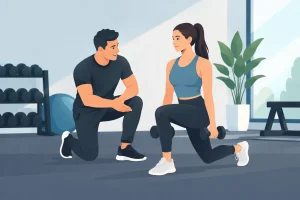
This is where coaching provides real value. A trainer can adjust resistance, range of motion, tempo, rest periods, and exercise selection in real time. If a movement is too easy, there is a clear progression. If it does not feel right, there is a smart alternative. That level of attention is difficult to get from a generic app or a busy group class.
For beginners, progress usually follows a simple pattern: first, movements feel more familiar. Then technique improves. Next, strength and work capacity begin to build. Physical changes often follow, but they are more sustainable when they come from repeatable habits rather than drastic measures.
Build a Schedule You Can Actually Keep
The best plan is not the one with the most workouts. It is the one you can follow consistently.
For many people new to exercise, two or three strength-focused sessions per week is an excellent starting point. That frequency leaves room for recovery while creating enough repetition to improve. Depending on your goals and current fitness level, your coach may add walking, low-impact cardiovascular work, mobility exercises, or a short home routine.
Thirty-minute personal training sessions can be highly effective when they are organized with purpose. There is no time wasted deciding what machine to use, waiting for equipment, or trying to copy someone else’s workout. In a private setting, the session stays centered on your program and your progress.
More is not always better. If your body is sore for days, your work schedule becomes chaotic, or the plan creates dread, the answer may be better programming rather than more discipline. A coach should help you find the appropriate training dose, then progress it as your fitness improves.
Learn the Difference Between Effort and Punishment
Beginners are often told that a workout only counts if they are drenched in sweat or unable to walk the next day. That is not a productive standard. Training should make you more capable, not repeatedly break you down.
Effort matters. You will need to work through moments that feel uncomfortable, especially as you build strength and cardiovascular fitness. But productive discomfort is different from poor form, uncontrolled fatigue, or pain. The goal is to train hard enough to create adaptation while protecting your ability to recover.
Private coaching is especially valuable for people who are nervous about exercise or returning after a long break. You can ask questions without feeling rushed or self-conscious. Your trainer can give direct feedback without competing for attention in a crowded facility. That comfort helps clients stay engaged long enough to see meaningful results.
Support Your Training With Practical Nutrition Habits
Exercise is one part of the fitness process. Dietary planning supports energy, recovery, body composition goals, and long-term health. It does not need to begin with a restrictive eating plan.
For many beginners, the most useful changes are straightforward: eat regular meals, include protein consistently, prioritize fiber-rich foods, drink adequate water, and plan ahead for busy days. The details depend on your lifestyle and goals. A person training for strength may need a different approach than someone focused on weight loss or improving heart health.
Be cautious about all-or-nothing rules. Cutting out entire food groups or trying to maintain an extreme calorie deficit can lead to low energy, poor workouts, and a cycle of starting over. A better plan is one that fits your real life, including business dinners, family meals, travel, and weekends.
Track Progress Beyond the Scale
The scale can be one data point, but it is not a complete report card. Daily weight changes can reflect hydration, sodium intake, digestion, and normal fluctuations. If weight loss is a goal, use trends over time rather than reacting to a single number.
A coach can also track progress through strength improvements, better movement quality, cardiovascular recovery, waist or body measurements, consistency, energy levels, and how your clothes fit. Sometimes the first major win is simply feeling comfortable enough to enter a training session with confidence.
Clear tracking keeps the program honest. If progress slows, the answer is not automatically a harder workout. Your coach may review sleep, nutrition, training frequency, stress, recovery, or whether the goal and timeline need adjustment. This is how personalized coaching stays responsive instead of rigid.
Choose an Environment That Helps You Show Up
Your training environment matters more than most people realize. If you dislike crowded gyms, feel uncomfortable exercising around strangers, or need to make the most of a limited window in your day, the setting can determine whether you remain consistent.
At UST Personal Training, clients train one-on-one in dedicated private rooms with experienced coaches and modern equipment. There is no membership pressure and no crowded floor to navigate. The focus remains on efficient, individualized training in a clean, distraction-free studio.
That privacy is not simply a luxury. For beginners, it can remove the hesitation that keeps progress on hold. When the experience feels professional, comfortable, and tailored to your needs, it becomes easier to keep the appointment you made for yourself.
Your starting point does not have to be dramatic. Choose a goal that matters, commit to a schedule you can sustain, and let sound coaching guide the next step. A strong fitness routine begins when you stop trying to prove yourself and start training with a plan.