
A knee that feels stiff after sitting through meetings. Hands that protest when opening a jar. A hip that makes stairs feel like a negotiation. Arthritis can make movement feel risky, but avoiding exercise altogether often leads to more stiffness, less strength, and less confidence in everyday life. Learning how to exercise with arthritis is not about pushing through joint pain. It is about choosing the right movements, the right dose, and a progression that respects where your body is today.
For many adults, especially those returning to fitness after a long break, the best program is not the hardest one. It is the one you can perform consistently, safely, and with enough individual attention to make adjustments before a small issue becomes a setback.
Why Exercise Helps Arthritic Joints
Arthritis affects joints differently depending on the type, the joints involved, your symptoms, past injuries, and your overall health. That is why generic workout plans can be a poor fit. Still, regular, appropriately scaled exercise is commonly used to support joint function, mobility, muscle strength, cardiovascular health, and day-to-day independence.
Movement helps circulate fluid within a joint and trains the muscles around it to do more of their share of the work. Stronger legs can reduce the demand placed on the knees during standing, walking, and stairs. Better hip and trunk strength can improve control during everyday movement. Improved cardiovascular fitness can make routine activities feel less taxing.
The trade-off is simple: too little activity can make joints feel more guarded and stiff, while too much intensity, volume, or impact can create a symptom flare. The goal is not to eliminate all sensation. The goal is to distinguish productive effort from a response that tells you the session needs to be modified.
Before beginning a new program, speak with your physician or qualified healthcare provider, particularly if you have inflammatory arthritis, a recent procedure or injury, significant swelling, unexplained pain, dizziness, chest symptoms, or a major change in your ability to bear weight.
How to Exercise With Arthritis Without Overdoing It
Start by treating exercise as a skill, not a test of toughness. Your first few weeks should establish tolerance, movement quality, and consistency. A private, guided setting can be especially valuable because a trainer can watch how your joints respond in real time and make precise changes to range of motion, resistance, tempo, or exercise selection.
A useful starting point is low-impact movement two to four days per week, with strength training on nonconsecutive days when possible. The exact schedule depends on your condition and recovery. A person with mild knee osteoarthritis may tolerate regular walking and two full-body strength sessions. Someone dealing with an active flare may need shorter, gentler sessions and more recovery between them.
Keep the first sessions deliberately manageable. Finish feeling like you could have done a little more rather than feeling depleted. That restraint gives you useful information about how your body feels later that day and the next morning.
Use the 24-hour response as feedback
Some mild muscle fatigue or temporary joint awareness during a new activity can be expected. What matters is the pattern afterward. If pain becomes sharp, swelling noticeably increases, your joint feels unstable, or symptoms remain meaningfully worse the next day, reduce the load, range, duration, or frequency before your next session.
A simple training log can help. Note the exercise, resistance, duration, discomfort level, and how you felt the next morning. Over time, this replaces guesswork with a clear record of what your body handles well.
Build Your Program Around Four Priorities
The most effective arthritis-friendly programs usually include four elements: mobility, strength, cardiovascular work, and recovery. They do not need to be long workouts. Well-designed 30-minute sessions can be highly effective when each movement has a clear purpose.
1. Start with mobility that prepares, not exhausts
A warm-up should make movement feel easier. Begin with five to 10 minutes of gentle activity, such as an easy stationary bike, treadmill walk, or low-resistance elliptical, depending on the joints involved and what feels comfortable.
Follow with controlled mobility work for the areas you plan to train. For example, ankle movement, supported hip motion, gentle knee bends, shoulder circles, or thoracic rotation may help prepare the body for strength work. Avoid forcing a joint aggressively into a painful position. More range is not automatically better if the joint is irritated.
2. Strengthen the muscles that support your joints
Strength training is often where people with arthritis need the most reassurance. Properly selected resistance exercises are not about heavy lifting for its own sake. They are about creating stronger support around the joints and improving your ability to move with control.
For knee arthritis, a program may prioritize quadriceps, hamstrings, glutes, calves, and trunk stability. For hip concerns, it may include glute strength, hip control, and balance work. For shoulder or hand arthritis, the approach may involve modified pressing, pulling, grip options, and carefully managed loading.
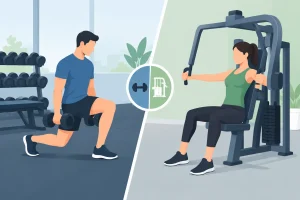
Machines, cables, benches, bands, and bodyweight exercises can all be useful. The best choice depends on your mechanics, confidence, available range of motion, and symptoms that day. A supported leg press may feel better than a free-standing squat for one person, while a box squat or sit-to-stand may be the smarter option for another.
Use a range of motion you can control without sharp pain. Slow repetitions, stable positions, and moderate resistance are often more valuable than chasing heavier weights. As strength and confidence improve, your trainer can progress one variable at a time – perhaps a few more repetitions, slightly more resistance, or a little more range.
3. Choose cardio that matches your joints
Cardiovascular exercise supports heart health, stamina, weight management when appropriate, and overall energy. It does not have to mean running. In fact, during periods of joint irritation, lower-impact options are often the better investment.
Walking may be excellent if your knees, hips, feet, and back tolerate it well. Stationary cycling can provide a smooth option for many people, although bike setup matters. An elliptical, pool exercise, rowing, or incline walking may also work depending on the person. There is no universal “best” cardio machine for arthritis.
Begin at a conversational effort. You should be able to speak in short sentences without gasping. Shorter blocks count: 10 minutes in the morning and 10 minutes later can be more realistic than forcing a single long session. Build duration before increasing intensity.
4. Give recovery the same attention as training
A productive program has room for recovery. Sleep, hydration, daily movement, stress management, and nutrition all affect how ready you feel to train. On stiffer days, gentle mobility and easy cardio may be more appropriate than a demanding strength session.
Rest does not have to mean complete inactivity. A brief walk, light stretching, or comfortable range-of-motion work can help you stay connected to the routine without adding unnecessary stress.
Exercises to Modify, Not Automatically Avoid
Arthritis does not create a permanent list of forbidden exercises. It changes the questions you ask. Does this movement cause sharp pain? Can you control it? Does it aggravate symptoms later? Is there a variation that achieves the same goal with less joint stress?
Deep squats, lunges, step-ups, overhead presses, gripping exercises, and impact activities may be appropriate for some people and poorly tolerated by others. The answer often lies in modification: reducing depth, holding onto support, changing foot position, using lighter resistance, shortening the set, or selecting a more stable variation.
High-impact jumping and rapid direction changes deserve extra care when joints are painful, swollen, or unstable. That does not mean an active person must never return to those activities. It means the return should be earned through strength, control, tolerance, and a sensible progression rather than forced on a bad day.
Signs You Need to Scale Back or Get Professional Input
Exercise should challenge you, but it should not leave you wondering whether you damaged something. Pause the activity and seek medical guidance when symptoms are severe, unusual, or escalating. Pay attention to these warning signs:
- Sharp or sudden joint pain, especially with a feeling of catching, giving way, or locking
- New or significant swelling, redness, warmth, or loss of motion
- Pain that consistently worsens for more than 24 hours after training
- Numbness, tingling, dizziness, chest discomfort, or shortness of breath beyond normal exertion
For less urgent but recurring discomfort, a qualified trainer can help identify patterns. Sometimes the answer is as practical as adjusting a seat height, changing the angle of an exercise, slowing the tempo, or reducing training volume for a week.
The Value of Personalized Coaching
A crowded gym can make arthritis-friendly exercise harder than it needs to be. You may feel rushed to use a machine, uncertain about form, or reluctant to modify an exercise in front of others. Personalized coaching removes much of that friction.
At UST Personal Training, one-on-one sessions in a completely private training room allow the program to focus on your specific joints, history, goals, and comfort level. Rather than being handed a generic routine, you can work through efficient, customized sessions with a trainer who can adapt every exercise as your strength and tolerance develop.
That level of attention matters whether you are new to exercise, rebuilding after injury, or simply tired of guessing which movements are helping and which are not. Private coaching also creates accountability without the pressure or distraction of a commercial gym floor.
Your joints do not need a perfect plan. They need a consistent, intelligent one. Start at a level that feels manageable, track your response, and let strength build gradually. The right session should leave you more capable of living your life, not less willing to move tomorrow.