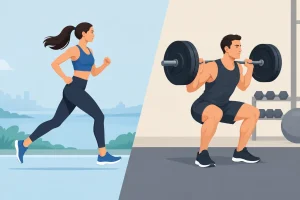
A leg press and a barbell squat can both build stronger legs. The better choice depends on far more than which station happens to be open. In the conversation around machines vs weights, the real question is not which tool is universally superior. It is which tool gives you the safest, most effective path toward your specific goal.
For some people, a machine creates the confidence and stability needed to train consistently. For others, free weights provide the challenge, coordination, and movement variety that move performance forward. At a premier private training studio, neither option is treated as a shortcut or an afterthought. Both are selected intentionally, coached carefully, and adjusted to the person using them.
Machines vs Weights: The Meaningful Differences
Weight machines guide your body through a fixed or semi-fixed path. Think of a chest press, leg curl, cable row, or leg extension. They typically let you adjust resistance quickly, sit or brace against a pad, and focus on the target muscle without managing as much balance.
Free weights include dumbbells, barbells, kettlebells, medicine balls, and weighted carries. They allow your body to move through a less restricted path, which often demands more coordination and control. A dumbbell press, for example, requires you to stabilize each arm while controlling the weight from start to finish.
That distinction matters, but it does not make one category automatically better. A machine is not “easy” simply because it is supported. A heavy leg press, controlled cable row, or challenging machine chest press can build serious strength. Likewise, free weights are not automatically more functional if technique is rushed, range of motion is poor, or the exercise does not fit your body.
The best training program uses equipment as a means to an end. Your anatomy, injury history, training experience, schedule, and goals should influence the decision.
When Machines Are the Better Choice
Machines are especially valuable when safety, consistency, and focused muscle training matter most. They reduce the balancing demands of an exercise, allowing many clients to produce effort where it counts without feeling overwhelmed by the setup.
For a beginner, that can be a major advantage. Learning to exercise should feel challenging, not intimidating. A machine can help someone understand how to create tension in the chest, back, legs, or shoulders before adding the complexity of dumbbells or barbells. This is useful for adults who are new to training, returning after a long break, or uncomfortable in a crowded gym environment.
Machines can also be an excellent option during recovery and rebuilding phases. That does not mean every machine is appropriate for every injury. It means the controlled environment can make it easier for a qualified trainer to limit range of motion, choose a manageable load, and monitor how a joint responds. Someone rebuilding lower-body strength may benefit from a supported movement before progressing to a more demanding squat variation.
They also make efficient training possible. In a focused 30-minute session, quick load changes and minimal setup can preserve valuable time. Instead of spending several minutes getting into position for a complicated lift, you can complete high-quality sets with clear intent, then move to the next exercise.
Machines are particularly effective for accessory work. After performing a demanding compound movement, a leg curl, cable pulldown, or chest-supported row can add targeted volume without asking a fatigued client to manage excessive balance or spinal loading.
Where Free Weights Have an Advantage
Free weights ask the body to coordinate movement under load. This can improve body awareness, grip strength, balance, and control, especially when exercises are taught and progressed properly.
A dumbbell split squat, for instance, trains the legs while requiring the hips and trunk to stabilize. A loaded carry develops grip, posture, and bracing while you walk. A barbell deadlift can build strength through the hips, hamstrings, back, and hands in a way few single machines can replicate.
Free weights also offer flexibility. Dumbbells allow each side of the body to work independently, which can expose and address strength differences. They can be adjusted to fit a client’s comfort and natural movement pattern more easily than a fixed machine designed around average body dimensions.
For experienced exercisers and athletes, free-weight training is often essential. The goal may be to improve force production, movement skill, power, or performance in a sport. These outcomes usually benefit from exercises that require full-body coordination.
Still, “free” does not mean careless. The more freedom an exercise allows, the more coaching and control it may require. A barbell is a powerful training tool, but it is not always the right first choice for someone with limited mobility, an active injury, or no experience managing load through a complex movement.
The Myth That Machines Do Not Build Real Strength
This idea persists because people often confuse free-weight skill with strength itself. A person who has practiced barbell squats will usually be better at barbell squats than someone who has only trained on machines. That does not mean the machine-trained person has not developed stronger leg muscles.
Strength is specific. You get better at what you practice, but muscle, connective tissue, and confidence can improve through both machines and free weights. If your goal is to build muscle, improve general fitness, support healthy aging, or feel stronger in daily life, machines can be highly productive.
The same applies in reverse. Free weights are valuable, but they are not a requirement for every goal. A carefully designed program does not chase an exercise just because it looks impressive on the gym floor.
The Smartest Programs Use Both
For most people, the answer to machines vs weights is not either-or. It is a strategic combination.
A session might begin with a free-weight movement that suits the client’s ability and goal, such as a goblet squat, dumbbell press, or Romanian deadlift. The rest of the workout may use machines and cables to add volume safely, reinforce specific muscles, and maintain quality as fatigue increases.
Another client may start entirely with machines to develop movement confidence and baseline strength. As control improves, their program may introduce dumbbells, carries, bodyweight movements, and other free-weight exercises. Progression is not about graduating away from machines. It is about expanding the tools available to you.
This approach is particularly effective for busy professionals. You do not need to spend an hour wandering from station to station or guessing which equipment will deliver results. A well-designed session matches the exercise to the objective, keeps the pace purposeful, and removes unnecessary complexity.
How Personal Coaching Changes the Decision
Equipment is only as useful as the plan behind it. The same leg press can be helpful for one person and inappropriate for another based on foot position, range of motion, loading, and the condition of the knees, hips, or back.
Personal coaching brings context to every choice. Your trainer can assess how you move, identify what needs attention, and select exercises that challenge you without creating needless risk. They can also make immediate adjustments when an exercise does not feel right, when your strength improves, or when life stress and recovery require a different approach.
At UST Personal Training, private-room coaching makes that process even more focused. There is no waiting for equipment, no pressure to perform in front of strangers, and no generic workout handed to every client. Your training time is centered on your body, your goals, and the highest-quality work you can complete that day.
Choose the Tool That Keeps You Progressing
If a machine helps you train with confidence, consistency, and excellent effort, it is doing its job. If free weights help you build strength, control, and athletic capability, they belong in your program. The right answer can change as your fitness improves.
The most productive workout is rarely the one built around a fitness trend. It is the one you can perform well, progress over time, and repeat consistently. Start with the movements that fit your current ability, then let expert coaching guide the next step forward.