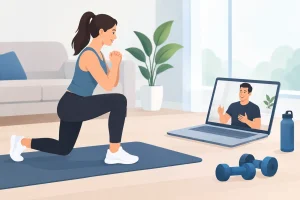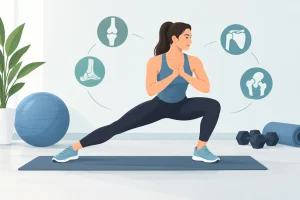

A deep squat should not feel like a negotiation with your hips. Reaching overhead should not pinch your shoulder. Getting up from the floor, carrying groceries, climbing stairs, and training with confidence all depend on how well your body moves. Mobility training is the focused work of improving that movement, not through random stretching, but by building usable range of motion and control.
For busy adults, mobility is often treated as an optional extra to fit in after the “real” workout. In practice, it can be the missing piece that makes strength training more productive, helps you return to activity with more confidence, and keeps everyday movement from feeling unnecessarily difficult.
What Mobility Training Actually Means
Mobility is your ability to move a joint through an appropriate range of motion with control. Flexibility is part of the equation, but it is not the whole picture. You may be able to pull your knee toward your chest or touch your toes, yet still lack the strength, balance, or joint control to use that range well during a squat, lunge, press, or golf swing.
That distinction matters. Passive stretching can temporarily make a muscle feel looser. Mobility work asks a more practical question: can you actively control your body in that position? A well-designed program may combine gentle range-of-motion drills, strength exercises, breathing, stability work, and movement patterns specific to your goals.
For example, someone who sits through long workdays may need better hip extension, upper-back rotation, and shoulder positioning. Someone returning to the gym after a setback may need to rebuild ankle control and confidence in a split squat. An experienced lifter may need enough shoulder and thoracic mobility to press overhead without compensating through the lower back. The exercise is never the entire solution. The assessment and progression are what make it useful.
Why Better Mobility Supports Better Training
Quality movement gives your strength work somewhere to go. If your hips, ankles, or upper back limit a squat, your body will often find a workaround. That may mean your heels rise, your knees collapse inward, your chest drops forward, or your lower back does more work than it should. These patterns are not always painful, but they can make an exercise less effective and more frustrating.
Improving mobility does not mean chasing extreme positions. Most people do not need gymnast-level flexibility. They need enough movement capacity for the activities and exercises that matter to them, paired with the strength to control it.
This is particularly valuable for adults rebuilding consistency. When movement feels stiff or unstable, it is easy to avoid training altogether. A personalized approach creates manageable wins: a smoother bodyweight squat, a more comfortable shoulder press, easier walks, or less hesitation getting down to the floor. Those wins build momentum.
Mobility Is Not a Quick Fix for Pain
Mobility exercises can be helpful when stiffness contributes to restricted movement, but they are not a diagnosis or a universal answer for pain. Sharp pain, persistent swelling, numbness, unexplained weakness, or symptoms that worsen with activity require evaluation from an appropriate medical professional.
Even without a medical issue, more range is not automatically better. Some clients are naturally mobile and need greater stability and strength, not aggressive stretching. Others may benefit from gradual mobility work before loading a pattern more heavily. The right plan depends on your history, goals, current movement, and how your body responds.
Where Most Adults Need More Movement Options
Every person is different, but certain areas commonly deserve attention because they influence so many everyday and training movements.
The ankles affect walking, squatting, lunging, and balance. Limited ankle motion can make it difficult to keep the heel down in a squat or control a step-down. The hips need to move in several directions while remaining strong enough to support the pelvis and lower back. Hip mobility is not just about stretching the hip flexors. It also involves control in rotation, flexion, and extension.
The upper back and shoulders work together for reaching, pulling, pressing, and posture. Desk work can encourage a rounded position for hours at a time, but the answer is not simply forcing the shoulders backward. Effective work usually combines upper-back movement with shoulder strength, proper pressing mechanics, and improved control of the shoulder blade.
The key is to avoid treating the body as separate parts. A restriction at the ankle may affect the knee and hip. Limited upper-back rotation may change what the shoulder or lower back has to do. Experienced coaching helps identify the movement pattern rather than guessing at the tightest-feeling muscle.
How to Build Mobility Into a Productive Workout
Mobility works best when it supports the session ahead. A long, generic stretch routine is not required before every workout. In many cases, five to 10 purposeful minutes can prepare your body more effectively than 30 minutes of unfocused stretching.
Start with a movement assessment. Watch how you squat, hinge, lunge, reach, rotate, and stabilize. This reveals more than a standard list of stretches ever could. From there, choose drills that address the specific limitation while reinforcing a better pattern.
Before lower-body training, a coach might use controlled ankle rocks, hip rotation drills, and bodyweight squat variations. Before upper-body training, the focus may shift to upper-back rotation, shoulder blade control, and light pressing or pulling movements. The preparation should make the coming exercises feel more stable and natural, not leave you fatigued.
Then reinforce the new range with strength. If you gain access to a better squat position but never load it appropriately, the improvement may not carry over. Exercises such as supported split squats, controlled deadlifts, step-ups, rows, presses, and carries can strengthen the ranges you are trying to improve. This is where mobility becomes durable.
The Private-Coaching Advantage
Mobility work is highly individual. Two people can both say, “My hips are tight,” while needing completely different strategies. One may need more hip motion. Another may already have plenty of motion but needs stronger glutes, better trunk control, or a more appropriate squat stance.
That is why private coaching can make a meaningful difference. In a distraction-free setting, your trainer can observe how you move, adjust exercise setup in real time, and progress the plan as your control improves. There is no pressure to keep pace with a class, copy the person next to you, or force an exercise that does not fit your current ability.
At UST Personal Training, private one-on-one sessions allow mobility, strength, cardiovascular fitness, and recovery considerations to work together in one efficient plan. For clients with demanding schedules, a focused 30-minute session can include the right preparation and high-value training without wasting time on routines that do not address their needs.
How Often Should You Do Mobility Work?
Consistency matters more than marathon sessions. Brief daily movement can be useful, especially if you spend long periods sitting, traveling, or working at a desk. Structured mobility and strength work two to three times per week is often enough to create noticeable progress when it is targeted and progressively trained.
Your schedule should match your goal. Someone preparing for a race, returning from a period of inactivity, or working around a known limitation may benefit from more frequent, low-intensity practice. Someone already moving well may only need a few focused drills built into regular workouts. Your body should feel more prepared after mobility work, not beaten up by it.
Pay attention to the results that matter outside the gym. Are stairs easier? Does your back feel less guarded after sitting? Can you reach, rotate, and carry with more confidence? Is your form more consistent when you train? These changes are often more meaningful than how deep you can stretch on any given day.
Better movement is not about performing impressive stretches. It is about giving your body the options, strength, and confidence to do what your life demands. Start with the movements that currently feel limited, train them with purpose, and let each small improvement make the next workout and the next day feel more capable.