
A productive workout should leave you feeling more capable, not simply exhausted. For busy adults, the difference comes from training with a plan: one that builds usable strength, improves cardiovascular capacity, and respects the time and energy you bring to each session. This strength and conditioning guide explains what that plan should include, how to progress safely, and why individualized coaching produces better long-term results than random workouts.
What Strength and Conditioning Really Means
Strength and conditioning is not reserved for athletes preparing for a season. It is a practical approach to fitness that helps you move better in everyday life, maintain lean muscle, protect joint function, improve stamina, and handle physical demands with more confidence.
Strength training focuses on producing force through movements such as squatting, hinging, pushing, pulling, carrying, and rotating. Conditioning improves how efficiently your heart, lungs, and muscles work during sustained activity or short bursts of effort. Together, they create a fitness base that supports everything from carrying luggage and playing with your children to returning to exercise after time away.
The best balance depends on the person. A beginner rebuilding confidence may need more time learning movement mechanics and developing basic strength. A busy professional with a solid training history may benefit from focused full-body sessions that keep rest periods efficient. Someone returning from an injury may require a slower progression, modified ranges of motion, and close attention to recovery. The program should fit the individual, not force the individual to fit a template.
A Strength and Conditioning Guide Starts With Assessment
Before adding weight, intensity, or fast-paced circuits, establish a clear starting point. A quality assessment considers more than a number on a scale. It looks at movement quality, current strength, mobility, previous injuries, training experience, lifestyle, sleep, stress, and the goals that matter most to you.
For example, limited hip mobility can change how a person squats. Shoulder discomfort may affect pressing movements. Low cardiovascular fitness may make long, high-intensity intervals more discouraging than productive. These are not reasons to avoid training. They are reasons to train intelligently.
A professional trainer uses this information to select exercises that are challenging without being careless. Progress may begin with a controlled goblet squat rather than a barbell back squat, or a supported row rather than an advanced pull-up variation. Starting at the right level builds momentum, reinforces good technique, and reduces the common cycle of doing too much too soon.
Build Around Fundamental Movement Patterns
A well-designed program does not need a complicated exercise menu. It needs the right movements performed with purpose. Most effective strength sessions include some version of a squat, hinge, push, pull, carry, and core stability exercise.
Squats train the legs and hips for standing, climbing stairs, and getting up from a chair. Hinge patterns, such as deadlift variations, develop the posterior chain: the glutes, hamstrings, and back muscles that support posture and powerful movement. Pressing and pulling balance the upper body, while carries build grip strength, core control, and overall resilience.
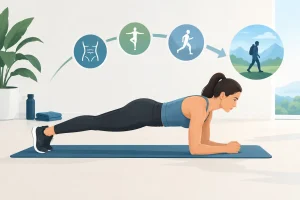
Core training deserves a more precise definition than endless crunches. A strong core helps you resist unwanted movement and transfer force efficiently. Exercises such as planks, dead bugs, loaded carries, and controlled rotational work can improve stability while supporting safer lifting mechanics.
Exercise selection should change only when there is a reason. Variety can make training engaging, but constantly switching movements makes it difficult to measure progress. Repeating key movements for several weeks allows you to improve technique, add resistance gradually, and see clear evidence that your effort is working.
Progress Without Chasing Exhaustion
Progressive overload is the principle behind improved strength and conditioning. Over time, the body must receive a slightly greater training stimulus to adapt. That can mean more weight, additional repetitions, better control, a longer carry, improved range of motion, or completing the same work with less rest.
More is not automatically better. Increasing every variable at once is one of the fastest ways to compromise form and recovery. A better approach is to make small, deliberate adjustments. If you performed eight technically sound repetitions last week, aim for nine or ten before increasing the load. If a heavier weight changes your posture or causes pain, it is not yet the right progression.
This is especially relevant for adults who have limited time. A focused 30-minute session can be highly effective when exercises are selected well, transitions are organized, and coaching keeps the work on track. The goal is not to cram as much fatigue as possible into half an hour. The goal is to create a repeatable training stimulus that moves you closer to your objective.
Conditioning Should Match Your Goals and Recovery
Conditioning is often mistaken for punishing cardio. In reality, it is a tool that can be adjusted to your current fitness level and desired outcome. Lower-intensity work, such as incline walking, cycling, or steady rowing, can improve aerobic fitness while being easier to recover from. Interval training can be useful for improving work capacity and making efficient use of time, but it requires appropriate exercise selection and dosage.
If your primary goal is fat loss, conditioning can increase overall activity and support calorie expenditure. It should not replace strength training, however. Building and preserving muscle helps maintain function and supports a stronger body composition outcome. Nutrition, daily movement, sleep, and consistency all matter as well.
If your goal is to feel less winded on stairs or during travel, a combination of steady aerobic work and controlled intervals may make sense. If you are preparing for a recreational sport, conditioning can become more specific to the movement demands of that activity. There is no single best conditioning format for every goal.
Recovery Is Part of the Program
Training creates the stimulus. Recovery is where adaptation happens. That does not mean you need a perfect routine, but it does mean the program should account for real life. A demanding work week, poor sleep, travel, or a lingering ache can change how you should train on a given day.
Prioritize adequate protein, regular meals that support your activity level, hydration, and consistent sleep whenever possible. Walking and light movement on non-training days can also support recovery without adding excessive stress. For many people, two or three well-coached strength sessions per week is a more sustainable starting point than trying to train intensely every day.
Muscle soreness is not a reliable measure of workout quality. Mild soreness can be normal when you are new to training or introduce a new exercise, but severe soreness that interferes with normal movement is not a badge of honor. Pain during an exercise, particularly sharp or worsening pain, should be addressed rather than ignored.
Why Private Coaching Changes the Experience
A crowded gym can make a good plan harder to follow. You may wait for equipment, feel unsure about your form, or spend more time deciding what to do than actually training. For beginners, that uncertainty can become a reason to stop. For experienced exercisers, it can limit the quality and efficiency of each session.
Private coaching removes much of that friction. At UST Personal Training, sessions take place in dedicated private rooms, allowing your trainer to focus fully on your technique, pace, programming, and comfort. The environment is clean, controlled, and free from the distractions of a commercial gym floor.
That level of attention is valuable at every stage. A trainer can adjust an exercise immediately if a movement does not feel right, progress your program when you are ready, and keep a 30-minute workout purposeful from start to finish. You do not need to know the equipment, build the plan, or wonder whether you are doing enough. You simply arrive ready to train.
The Standard That Produces Lasting Results
The strongest program is the one you can perform consistently. It should challenge you, but it should also fit your schedule, respect your current ability, and give you a clear sense of progress. There will be phases where strength is the priority, periods when conditioning takes more focus, and weeks when recovery needs to lead the decision-making.
Start with movements you can control, train them with excellent form, and progress patiently. A private, personalized setting can make that process feel more comfortable from the first session, especially if traditional gyms have never felt like the right fit. Give your training the structure it deserves, and let each focused session become proof of what your body can do.